
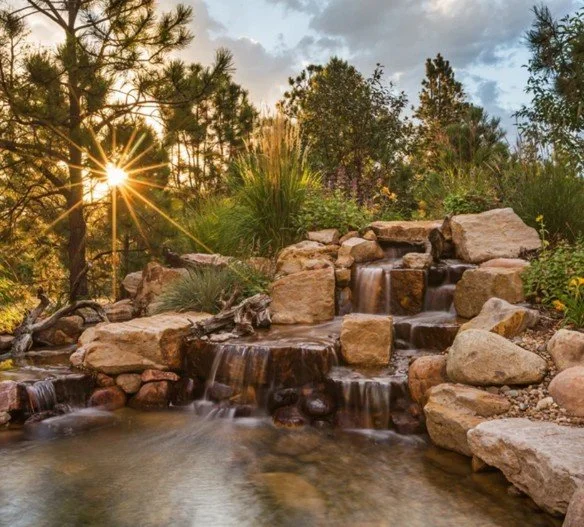
Behind every water feature in North Texas sits a small plumbing system wearing a stone jacket. A pump moves the water, valves control where it goes, a filter keeps it clear, and an autofill quietly replaces what a Fort Worth, TX summer takes out of it. Hiring a water feature contractor is largely a decision about who owns that equipment and who still reaches it once the stone is set.
Hillman Outdoor Living brings over two decades of design-build experience across the DFW area, and today the company operates with a team of dedicated and talented professionals. The features still running quietly after several seasons are the ones where the equipment was given somewhere sensible to live and the water losses were worked out before the basin was poured.
This guide covers where the water goes in a North Texas summer, how much make-up water a basin needs, where pumps and valves belong, how much service access has to be designed in, and how a real leak is told apart from a hot July.
Related: Why Water Features Are Essential in Your Pool Remodeling Project in Southlake and Keller, TX
Where Does the Water in a Fort Worth Water Feature Go?
The water in a Fort Worth water feature leaves four ways, and evaporation is much the largest. Open water under full Texas sun loses depth every day the temperature climbs, and a wide shallow basin loses considerably more than a deep narrow one holding the same volume.
Splash and wind take the second share. A tall spillway dropping onto open water throws spray, and a southerly breeze across an exposed basin carries a surprising amount of it onto the deck rather than back into the catchment.
Wicking is the third and the one that gets missed. Water climbs the back of a stone face, finds the joint behind it and leaves through the ground instead of the air, which is how a feature drops overnight with nothing visibly wrong on the surface.
The fourth is a genuine leak, and it is the rarest of the four. Treating every loss as a leak means chasing plumbing that is working correctly, while treating every loss as evaporation lets a real one run unnoticed for a whole season.
Why Does Surface Area Decide Water Feature Loss?
Surface area decides water feature loss because evaporation happens at the surface, not in the volume. A shallow reflecting basin spreads its water thin across a large opening, while a deep spill pool holding the same volume presents far less of itself to the sun and the wind above it.
That is a design lever rather than a fixed cost. Narrowing an opening, deepening a basin, or siting a feature where the house throws afternoon shade across it each cut the loss without changing how the water looks or sounds.
How Much Make-Up Water Does a North Texas Summer Demand?
A North Texas summer demands more make-up water than most homeowners expect, and the figure is driven by surface area rather than by volume. A broad basin in July gives up a measurable fraction of an inch of depth on a hot, dry, breezy day, and spread across a large surface that becomes real water quickly.
Humidity and wind shift the number as much as temperature does. A still, humid August evening costs very little, while a dry and windy afternoon in the high nineties costs several times as much out of the same basin.
This matters at the design stage because it sets the reservoir size. A basin sized tightly against the pump’s requirement runs low during a hot week, and a pump that runs dry is a pump being replaced, while making the hidden reservoir generous is inexpensive while the excavation is still open.
Water feature design should start with that calculation rather than with stone selection, because reservoir volume decides how forgiving the finished feature is in August.
How Should a Water Feature’s Hidden Reservoir Be Sized?
A water feature’s hidden reservoir should be sized backward from the worst week rather than the average one. A reservoir covering several days of peak loss means a household that travels in July comes home to a working feature instead of a dry pump and a burnt seal.
The extra volume costs little at construction and buys a great deal of margin later. It also gives an autofill time to catch up after a hot spell, and it keeps a small, slow leak from turning into a dry pump before anyone notices the level dropping.
What Does a Water Feature Autofill Do, and Where Does It Belong?
A water feature autofill replaces what the air removes without anybody thinking about it, using a float valve plumbed to a dedicated supply line. On a feature running through a Texas summer, that is the difference between a weekly chore and a system that looks after itself.
Placement decides whether it earns its keep. The valve belongs inside a chamber that opens without lifting stone, set at a level matching the operating water line, and on a line carrying its own shutoff so it is isolated without closing down the house supply.
An autofill also masks a leak, which is the argument for a meter or at least the habit of watching it. A feature quietly drawing make-up water around the clock looks entirely healthy until a water bill says otherwise.
Backflow protection belongs in the same conversation. A supply line feeding an open basin needs the appropriate device fitted so basin water does not travel back toward the house, and that is a code requirement rather than a preference.
Where Should Water Feature Pumps and Valves Live?
Water feature pumps and valves belong somewhere dry, ventilated, reachable and out of the sightline. Those four requirements pull against each other often enough that the equipment position deserves resolution on a drawing rather than on the morning the plumber arrives.
Distance costs head pressure. A pump sited a long way off, or fed through undersized pipe with several tight turns, works harder to produce the same spill and draws more power doing it through a Fort Worth August.
Noise carries further than people expect across hard surfaces. Equipment tucked against a masonry wall near seating reflects sound straight back at the people sitting there, and a quiet pump is undone by where somebody put it.
Our patios, walkways and driveways get laid out with the equipment route already drawn on them, because a line that has to cross a finished surface afterward means lifting that surface.
How Is Water Feature Equipment Kept Out of Sight?
Water feature equipment stays out of sight through planting and masonry settled at the design stage. A low wall, a hinged access panel or a planting pocket in front of the chamber conceals equipment without boxing it in, provided one person moves the screening aside easily.
The screen has to be planned with the service route rather than against it. Shrubs that grow across a chamber lid within two seasons, or a decorative panel fixed with masonry screws, turn a five-minute check into a job nobody does.
How Much Service Access Does a Water Feature Need?
A water feature needs enough service access to kneel, get both hands in and lift a component clear. A chamber that technically contains the pump but requires it to come out through a six-inch gap is not accessible; it is a future demolition with a lid on it.
Every item wants its own reachable isolation. A valve on the autofill, one on the suction side and one on the return together let a pump be swapped without draining the system, which turns an afternoon into about ten minutes.
Lids belong on the plan rather than in the field. An access lid set flush into paving, positioned where furniture does not stand over it, is close to invisible, while one located after the fact tends to end up in the middle of the walking route.
Filters deserve the shortest route of anything, because they get handled most often. Putting a filter at the far end of a run and behind planting guarantees it gets cleaned less frequently than it should be.
How Should a Water Feature Be Designed for the Next Owner?
A water feature designed for the next owner has labeled valves, a reachable chamber and an obvious shutoff. Not every household stays put, and a feature that a future owner or a visiting technician understands within a few minutes is one that keeps running rather than getting switched off.
A short set of notes left with the house does the rest. A simple drawing showing where the equipment sits, which valve does what and how the autofill is isolated costs nothing to produce at handover and saves the next owner an afternoon of guessing.
Related: Create Your Arlington, TX Oasis With Expert Inground Pool and Patio Construction
What Does Hard North Texas Water Do to a Water Feature?
Hard North Texas water leaves its minerals behind in a water feature. Evaporation removes water and leaves dissolved calcium in the basin, so concentration climbs steadily through a long summer even while the autofill holds the level perfectly steady.
The visible result is a pale line on the stone at the water mark and a rough deposit along the spillway edge where the running film is thinnest. On dark stone it appears sooner and reads worse.
Material choice changes how much any of that matters. Dense stone with a tight surface sheds deposits far more readily than a porous one, and a spill detailed with a clean drip edge keeps the running film off the face underneath it.
Where a scupper or spill runs off one of our retaining and seating walls, the stone on that face is specified with running water in mind.
How Are Mineral Deposits on a Water Feature Managed?
Mineral deposits on a water feature are managed by dilution rather than by scrubbing. Draining and refilling part of the volume through a long summer dilutes what evaporation has concentrated, and that keeps the water line cleaner than any amount of cleaning later.
That routine belongs in the maintenance notes for any feature with a visible spill face. A partial drain every few weeks in peak season is a small habit, and it keeps the stone looking the way it did the week it was finished.
How Is a Water Feature Leak Told Apart From Ordinary Evaporation?
A water feature leak is told apart from ordinary evaporation with a bucket and a day. A bucket of water set on a step inside the feature loses depth at exactly the evaporation rate, so if the basin drops faster than the bucket does, the difference is a leak.
Running that test twice tells a good deal more. Once with the pump running and once with it switched off separates a leak in the basin shell itself from one in the plumbing or at the spill lip, which narrows the search considerably before anything gets opened up.
The usual culprits are fairly predictable. A settled joint at the spill lip, a failed seal where pipe passes through the shell, and water tracking behind a stone face account for most leaks in finished features.
Timing matters when running the test. Comparing across a cool, still night rather than a hot and windy afternoon shrinks the evaporation component considerably, which makes a small leak far easier to pick out of the numbers.
What Changes When a Water Feature Sits Beside a Pool?
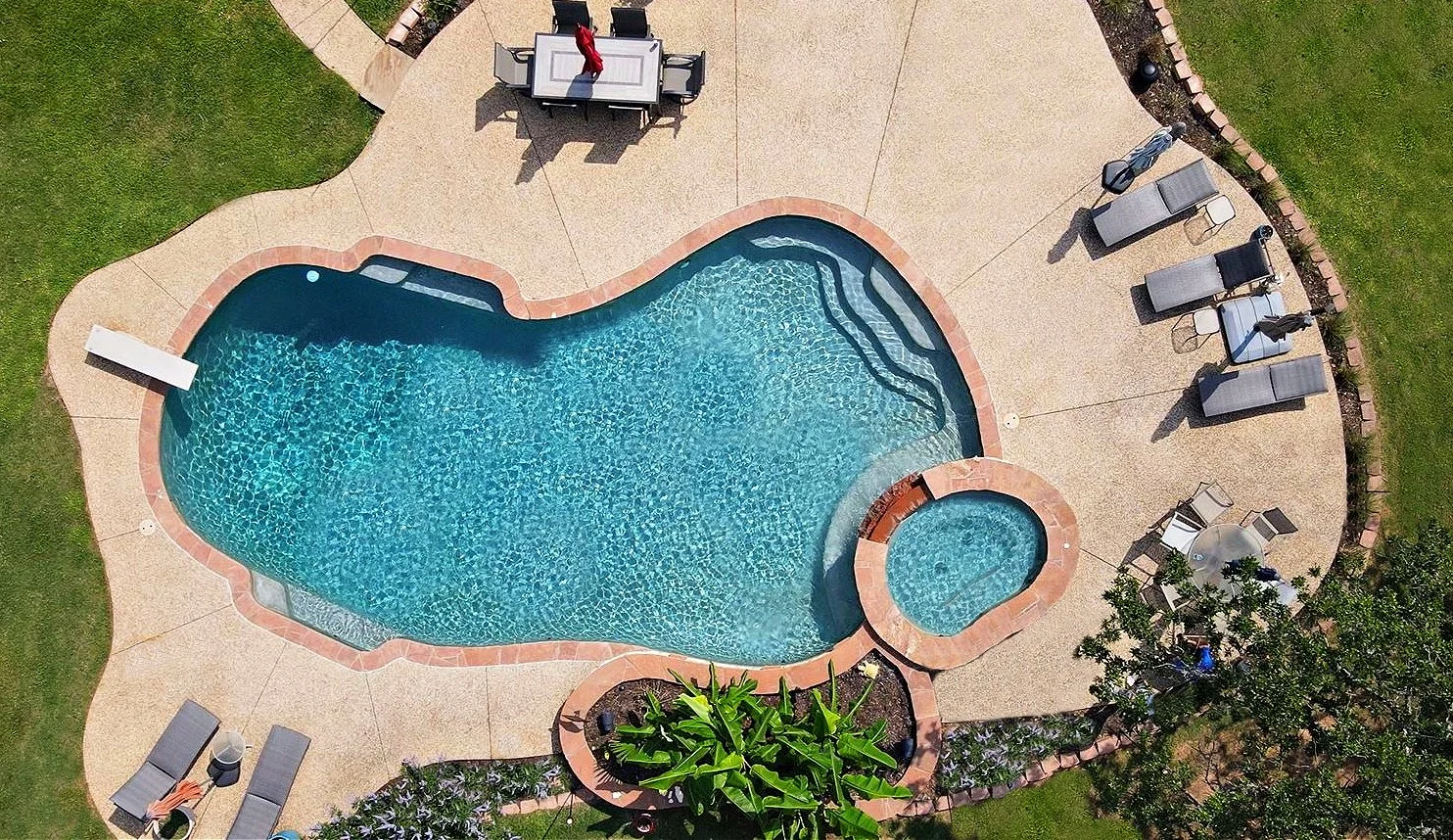
Beside a pool, a water feature usually shares the pool’s equipment. A spillover spa or a sheer descent fed off the pool’s own system runs on the same pump, filter and sanitizer, which simplifies the plumbing and binds the two together for maintenance.
Our gunite inground pools treat a feature as part of that hydraulic system rather than as an attachment.
Valve arrangement then decides how usable it turns out to be. A feature on its own actuated valve runs independently of the main circulation, so nobody has to choose between filtering the pool and hearing moving water.
Chemistry carries across as well. Aeration from a spill pushes pH upward over a summer, which is entirely manageable but worth understanding before a feature is added to a pool that was balanced without one.
Which Questions Show a Water Feature’s Equipment Was Planned?
Five questions show a water feature’s equipment was planned. Ask where exactly the equipment sits and how it is reached, what the reservoir volume is and how many days of summer evaporation it covers, and whether there is an autofill and on what supply.
Then ask two more that separate contractors quickly: which isolation valves are fitted and where, and who services the feature in its second year. A contractor who answers all five standing in the yard has built features that were still working when somebody came back to them.
Those answers tend to arrive quickly or not at all. Somebody who has gone back to service their own installations describes the chamber and the valve positions without pausing, because they have knelt beside them more than once.
Work With a Water Feature Contractor in Fort Worth, TX Who Plans the Equipment First
Sizing the reservoir, siting the pump, drawing the service route and settling the autofill supply takes an afternoon and decides most of what determines how a feature runs in five years.
Our team would far rather spend that afternoon with a tape and a hose bib than come back later to open a finished terrace.
Add a water feature to your Fort Worth, TX yard with Hillman Outdoor Living. Schedule your water feature consultation with Hillman Outdoor Living.
In Summary
How much water will a feature in Fort Worth, TX lose during a hot week?
A water feature in Fort Worth, TX loses an amount set by its exposed surface area rather than by how much water it holds. A wide, shallow basin in full sun during a dry, breezy stretch gives up a fraction of an inch of depth daily, which across a large surface becomes several inches over a week, and that is why the hidden reservoir gets sized with a hot week already allowed for.
Can a water feature be added to a pool that is already finished?
A water feature often goes onto a finished pool, with the cost depending on where the equipment pad sits and whether spare plumbing was run at the time. Adding a spill fed off the existing system usually means new pipe, an actuated valve and a tie-in at the pad, so a small area gets opened to see what is available before quoting rather than assuming the original installer left capacity.
How much attention do the pump and filter need through the summer?
The filter wants checking every few weeks in peak season, more often where trees or planting sit upwind of the basin, while the pump itself generally needs little beyond a dry, ventilated chamber clear of debris. Hillman Outdoor Living plans the equipment route and access at the design stage, because features that get neglected tend to be the ones where somebody has to move furniture or lift a stone to reach anything.
Related: What a Landscaper Actually Does (And Why It Matters More Than You Think) in Fort Worth, TX